Certainly not papyrus or parchment! Popular with tourists are the slabs of marble with holes in them that served as public toilets. We sat on them at Ephesus. What's the deal with the pear-shaped holes? Senators and others who may have strolled along the agora would have modestly sat on the toilets, arranging the folds of their robes to cover all private parts. If they did not have slaves accompanying them to take care of necessities, they had to do it themselves. A natural sea sponge attached to a long stick served as the wiping device. The smaller part of the toilet opening, like the neck of the pear, was large enough for the sponge. When it was withdrawn, it was cleaned in the water trough and left for the next person using the public toilets.
Thursday, August 27, 2009
What did the ancient Romans use for toilet paper?
Certainly not papyrus or parchment! Popular with tourists are the slabs of marble with holes in them that served as public toilets. We sat on them at Ephesus. What's the deal with the pear-shaped holes? Senators and others who may have strolled along the agora would have modestly sat on the toilets, arranging the folds of their robes to cover all private parts. If they did not have slaves accompanying them to take care of necessities, they had to do it themselves. A natural sea sponge attached to a long stick served as the wiping device. The smaller part of the toilet opening, like the neck of the pear, was large enough for the sponge. When it was withdrawn, it was cleaned in the water trough and left for the next person using the public toilets.
Wednesday, August 12, 2009
100% Handmade Artwork
The Turkish carpet that I purchased in Avanos has arrived! Because it's made of wool and cotton, the pattern is intricate, making it more valuable than a solid wool carpet. The reverse side, in fact, is nearly as lovely as the front. Woven in Kaysuri by the Yun Bunyan family (Turkish-Armenian), the design is a medallion surrounded by an arabesque motif. I knew I liked it the minute I saw it in the weaving demonstration room, but had no idea that it would be within my budget. Indeed, it is lovely.
Sunday, August 9, 2009
A Turkish breakfast followed by a movie
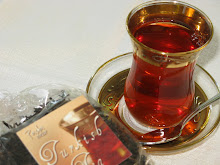
Tony wanted waffles this morning, but that's not what I needed. He fixed his while I prepared mine. Mine included the staples of a traditional Turkish breakfast: five-minute boiled egg, fresh tomato wedges, fresh cucumber, yogurt (Greek since I can't purchase Turkish in this part of the country), whole-grain toast (although Turkish simit would have been perfect), honey, and black tea.
After breakfast we actually treated ourselves to a movie at the cinemaplex (a whopping $13 for two seniors). I wholeheartedly agree with Time magazine's arts reviewer, Mary Pols, that Meryl "Streep's performance is a hoot and a joy. It's not just a demonstration of tremendous skill; it's emotional persuasion." Streep masters Julia Child's personality, joie de vivre, and chirpy, high-pitched accent. I've read that Streep thoroughly enjoys the challenges of different accents. Regardless of what the film critics write, I think Nora Ephron gives viewers a splendid screen adaptation of both books.
Julie and Julia is a "feel good" movie--not a "chick flick"--with absolutely nothing offensive in it. Tony and other guys laughed out loud on several occasions, especially at Tucci's performance--definitely believable--as Julia's husband. Although several film critics say they could hardly wait for the camera to pan to Julia after segments focusing on Julie, I think Amy Adams is engaging in her portrayal of a Queens resident who posted daily to her blog as she cooked her way through Child's recipes.
I've seen Julia Child's modest kitchen in the Smithsonian, and it reminds me of my grandmother's. If Julia could see the movie and the museum installation of her kitchen, I think she would say that today's marble countertops and state-of-the-art appliances have little impact upon the quality of food preparation. We should be inspired by her passion and persistence. Yes! Bon appetit!
Saturday, August 8, 2009
Tulip & arabesque
Throughout history the tulip and arabesque motifs have had multiple meanings. We know that the tulip was used as a heraldic symbol at the height of the Ottoman Empire. Almost any repetitive or geometric pattern falls under the arabesque category with the exception of human forms, taboo in the Islamic world. Islamic arabesque, whether geometric or undulating and repetitive vines, is a characteristic motif in Turkish ceramics, tiles, and carpets.
My certificate of authenticity that came with the plate from Firca (pottery factory built inside a cave) in Avanos states that it is family-designed art by Mustafa Cakir. The salesman told me that Mustafa, whom he identified as his brother, created this among his final pieces before he passed away a few years ago. I particularly like the juxtaposition of the contemporary tulips against the repetitive background. When I rub my hand across the plate, I feel the raised dots created with slip. With my limited knowledge of ceramics, I know that creating such an intricate pattern would require a steady hand, patience, and expert vision.
Friday, August 7, 2009
Taste of Turkey
I decided to share a "Taste of Turkey" yesterday at the Instructional Services Center to get the word out about the Fulbright-Hays Summer Abroad opportunity. I served mercimek corbasi (red lentil soup), ekmek (bread), rice and chickpea salad, dill and cucumber with yogut salad that is more a dip for bread (as it was served in Turkey) than salad, and fresh cherries. The corba was a hit. My big crock pot of soup was empty within 30 minutes of serving! I think I've mastered the recipe. The secret is to add more paprika and mint than the recipe specifies. Oh, and cay, of course! I think everyone who drank elma (apple) cay liked it more than black Turkish tea. Elma cay is quite light and refreshing for summer.
I purchased the colorful scarf (draped across the endge of the table in the photo)in the lovely town of Antalya, a Turkish resort area on the Mediterranean. That's where I had to ice my sprained ankle for six hours. The following day was our first "free" day. I sat under an umbrella beside the Med and read and wrote a few post cards. It seems like a dream.
Thursday, July 30, 2009
Back to the old grind
Today I went back for my first full day of work since our return from Turkey. All the speciaists, several secretaries, and a couple of supervisors were so impressed with what I have learned about the Turkish art of water marbling that they asked me to teach them how to do it. Ayla Makas, the ebru instructor does not offer brushes or paints for sale on her website (www.aylamakas.com). I'll have to begin searching for the necessary materials.
Tuesday, July 28, 2009
Mercimek Corbasi
All went well yesterday until we reached JFK. Due to inclement weather, flights were delayed and cancelled. My flight from JFK to Norfolk was delayed two hours as was Jim Hauf's to St. Louis, but, what a relief to finally board the aircraft! After 30 minutes on the runway I overheard another passenger grumble, "Are we planning to taxi all the way to Norfolk?"
Actually, I walked through the door of our house at 3 o'clock in the morning. In Istanbul it ws already 10 o'clock in the morning. I decided to stay up, unpack my luggage, and do laundry. As soon as Tony left for work, I went to the grocery store. The abbreviated version of this story is that I purchased the ingredients for soup and prepared mercimek corbasi for dinner. Nothing hits the spot like good Turkish soup. I'll include the recipe that I used (to which I added additional mint and paprika) from TURKISH COOKING (ISBN 978-975-7199-76-2) :
MERCIMEK CORBASI (red lentil soup)
1 large chopped onion (red)
2 carrots
1 large potato
1 glass red lentils (1 cup)
6 glasses vegetable broth (6 cups)
1 T butter
1/4 glass of cream (1/4 cup whipping cream)
salt and pepper to taste
1/2 T butter
1/2 T dried mint
1/2 tsp paprika
2 T melted butter
Place onion, carrots, and potato in pressure cooker for about 10 minutes to soften. Add lentils, broth, seasoning, and mint. Cook over low heat stirring from time to time. (Remove from burner.) Add cream and blend with food processor. Season to taste (additional mint and paprika). Return to pan and simmer for a few minutes. Garnish and serve.
Subscribe to:
Posts (Atom)